
Last Updated: June 19, 2026
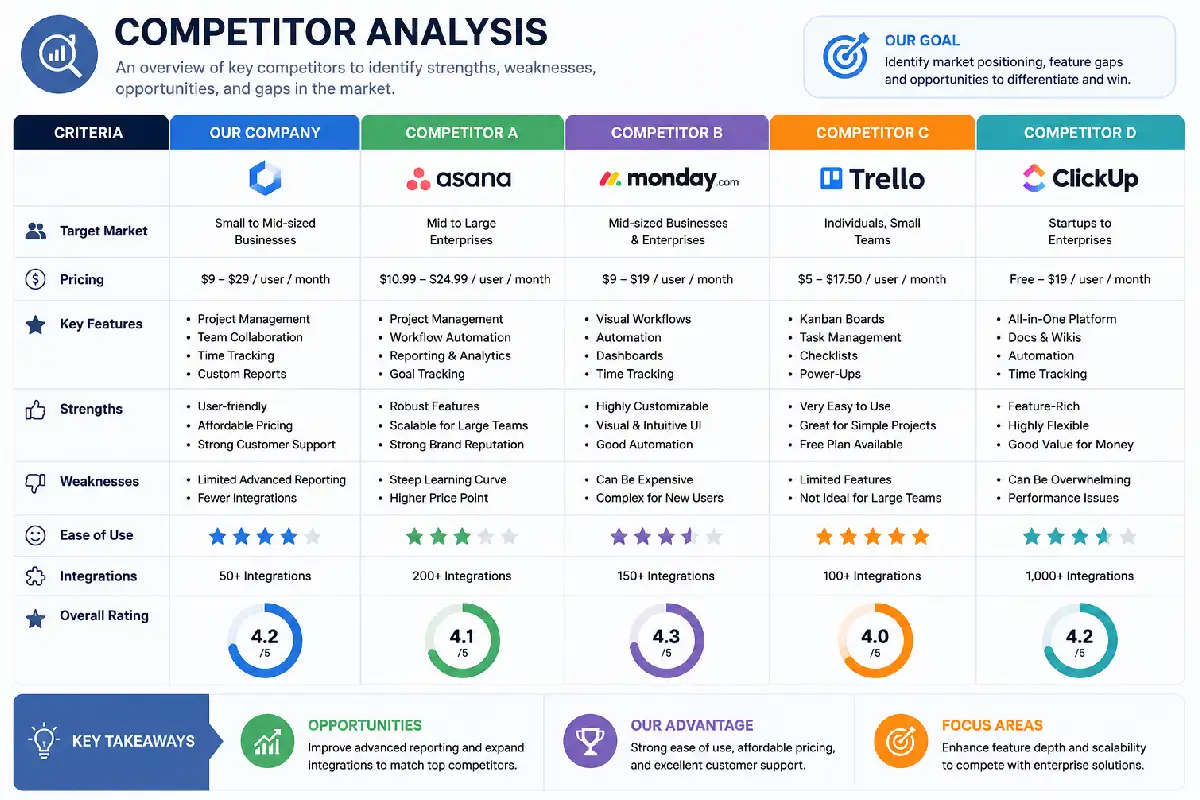
Competitor analysis is the process of identifying, evaluating, and understanding your business competitors to gain insights into their strategies, strengths, weaknesses, and market positioning. It helps a business improve its strategy, differentiate its offerings, and make informed decisions.
Competitor analysis is a core part of business strategy, marketing planning, and product development. It is crucial to your marketing strategy, reacting to your competitors’ actions. Let us know how to do it and what are the advantages of its implementation.
What is a Competitor Analysis?

Competitor analysis permits you to identify your strengths and weaknesses to anticipate market threats and comprehensively understand what makes you different from a customer perspective. Knowing these advantages will allow you to face the competition’s strategies and use your skills fully. This information is essential to optimize corporate strategy, develop a marketing plan or create an effective business plan. Similarly, conducting competitor surveillance is essential to counter marketing and commercial offensives by key competitors.
Why Competitor Analysis is Important
Competitor analysis is a critical part of business strategy because it helps companies understand the market landscape, anticipate challenges, and make informed decisions. By examining competitors, businesses can identify opportunities, reduce risks, and improve their own performance.
- Identify Market Opportunities
- Studying competitors helps uncover gaps in the market that are underserved.
- For example, if competitors offer limited eco-friendly options, your business can introduce sustainable products to capture that segment.
- Benchmark Performance
- Competitor analysis provides a yardstick to compare your products, services, and strategies.
- It helps assess if your pricing, quality, or customer service is competitive.
- Improve Strategic Decision-Making
- Insights from competitors guide marketing campaigns, product development, and pricing strategies.
- For example, if a competitor’s social media engagement is high, you can adopt similar or better strategies.
- Understand Customer Preferences
- By analyzing competitors, you can learn what customers like or dislike in products and services.
- Helps in designing products that better meet customer needs.
- Anticipate Threats
- Competitor analysis highlights potential threats, such as new product launches or emerging companies.
- Helps businesses prepare and adapt proactively rather than reacting too late.
- Enhance Innovation and Differentiation
- Understanding competitors’ strengths and weaknesses allows your business to innovate and offer unique solutions.
- Helps stand out in the market and attract loyal customers.
- Support Long-Term Planning
- Continuous competitor analysis informs expansion, investment, and strategic planning.
- Helps businesses stay agile and responsive to market changes.
Example of Competitor Analysis for Companies
India
| Company | Industry | Competitor | Strengths | Weaknesses | Opportunities | Threats |
| Coca-Cola | Beverages | Pepsi | Strong brand recognition, global distribution, diverse product portfolio | High sugar content criticism, limited low-calorie options | Expand in healthy drinks, new flavors | Growing health-conscious market, competition from local brands |
| Pepsi | Beverages | Coca-Cola | Popular snacks and beverage combo, strong marketing campaigns | Brand overshadowed by Coca-Cola globally | Diversify into healthier options | Health trend, carbonated drink decline |
| Amazon | E-commerce | Walmart | Wide product selection, fast delivery, strong tech infrastructure | Thin profit margins in certain categories | Expand in groceries, international markets | Regulatory scrutiny, rising competition |
| Walmart | Retail / E-commerce | Amazon | Extensive physical store network, low prices, strong supply chain | Limited online tech compared to Amazon | Online grocery and e-commerce expansion | E-commerce competition, changing shopping habits |
| Zomato (India) | Food Delivery | Swiggy | Strong brand presence, large restaurant network | Dependence on promotions, thin margins | Cloud kitchens, subscription models | Rising competition, delivery cost hikes |
| Swiggy (India) | Food Delivery | Zomato | Fast delivery, app user experience, aggressive marketing | Limited international presence | Partnerships with restaurants, vertical expansion | Market saturation, regulatory changes |
UK
| Company | Industry | Competitor | Strengths | Weaknesses | Opportunities | Threats |
| Tesco | Retail / Supermarket | Sainsbury’s | Extensive store network, strong brand loyalty, online grocery delivery | Dependence on UK market, price competition | Expand online services, sustainability initiatives | Aldi, Lidl discount competition, Brexit-related supply issues |
| Sainsbury’s | Retail / Supermarket | Tesco | Strong private-label products, online delivery platform | Higher prices than discounters, limited international presence | Health-focused products, e-commerce expansion | Competition from Tesco & discounters |
| Vodafone UK | Telecommunications | BT | Large mobile network coverage, global brand recognition | Customer service complaints, pricing competition | 5G network expansion, IoT services | O2, EE competition, regulatory changes |
| BT Group | Telecommunications | Vodafone UK | Strong broadband infrastructure, bundled services | Slower mobile network rollout, customer service challenges | Fibre broadband growth, smart home solutions | Competitive mobile market, technological disruption |
| Deliveroo UK | Food Delivery | Uber Eats | Fast delivery network, strong restaurant partnerships | Dependence on urban areas, thin profit margins | Cloud kitchens, subscription services | Uber Eats & Just Eat competition, regulation of gig economy |
| Uber Eats UK | Food Delivery | Deliveroo | Large global brand, app usability, marketing reach | Limited profitability, high delivery fees | Expansion into new cities, partnerships with supermarkets | Strong local competitors, rising operational costs |
London
| Company | Industry | Competitor | Strengths | Weaknesses | Opportunities | Threats |
| Barclays | Banking & Financial Services | HSBC UK | Strong brand reputation, wide retail network, diversified financial services | High operating costs, legacy systems | Digital banking expansion, fintech partnerships | Competition from fintech startups, regulatory changes |
| HSBC UK | Banking & Financial Services | Barclays | Global presence, strong corporate banking, wealth management | Less focus on UK retail customers | Green finance, digital transformation | Brexit-related market shifts, regulatory pressure |
| Deliveroo (London HQ) | Food Delivery | Uber Eats London | Large network of restaurants, fast urban delivery | Dependence on city-based customers, thin margins | Expansion into suburban areas, subscription models | Uber Eats, Just Eat competition, gig economy regulations |
| Just Eat UK | Food Delivery | Deliveroo London | Strong brand recognition, large customer base | Lower delivery speed in urban areas | Partnerships with more restaurants, loyalty programs | Competition from Deliveroo and Uber Eats |
| BP (British Petroleum, London HQ) | Energy / Oil & Gas | Shell UK | Global energy brand, diversified energy portfolio | Dependence on fossil fuels, environmental criticism | Renewable energy investments, EV charging networks | Climate regulations, renewable energy competitors |
| Shell UK | Energy / Oil & Gas | BP London | Strong global supply chain, R&D capabilities | Environmental impact, regulatory scrutiny | Clean energy solutions, hydrogen technology | BP competition, government regulations, market volatility |
How to Make a Competitor Analysis?
First of all, analyze your business; finish a SWOT analysis, or SWOT analysis, which will assist you in classifying the fortes and weaknesses of your business. It also classifies the threats and chances the company could face due to external factors, thus making its market strategies. In competitive analysis, you must now assess the strengths and weaknesses of your competitors and identify opportunities or situations that may also pose a threat to you.
The first competitive analysis step is identifying your current and potential competitors. There are two ways to do this:
- Take the customer’s perspective
- From your point of view
Looking at it from the customer’s perspective, you’ll see its key strengths and weaknesses. In other words, you do the first part of the SWOT analysis. Think like a customer. Why should a client use your services? Is it for they do things differently or because the quality is top-notch? Put physically in your customers’ shoes and ask why you go to them instead of your own company.
How are Salesforce Can Assist with Competitor Analysis?
| Feature / Tool | How It Helps with Competitor Analysis |
| CRM Database | Stores detailed data about competitors, leads, and customers, enabling tracking of competitor connections. |
| Occasion Management | Tracks deals lost to competitors and reasons, helping identify competitors’ fortes and weaknesses. |
| Reports & Dashboards | Generates visual reports on contestant activity, win/loss rates, and market trends. |
| Sales Cloud Insights | Provides real-time visions into competitor products, pricing, and market placement. |
| Marketing Cloud | Screens competitor marketing campaigns and customer engagement leanings. |
| Social Studio | Tracks contestant social media activity, references, and customer sentiment. |
| AI & Analytics (Einstein Analytics) | Forecasts competitor behavior, market trends, and opportunities to recover competitive positioning. |
| Collaboration Tools (Chatter, Slack Addition) | Allows teams to share contestant intelligence and coordinate strategic replies. |
| Custom Dashboards | Visualizes contestant comparisons by product, valuing, region, or customer section. |
| Alerts & Notifications | Notifies sales and advertising teams of contestant activity and market changes. |
Website Competitor Analysis
The process of assessing competitor websites to appreciate their products, services, design, content, SEO, and digital strategies. It helps you classify strengths, weaknesses, and opportunities to improve your website’s concert and market positioning.

| Website | Industry | Traffic (Monthly) | SEO Ranking / Domain Authority | Content Strategy | Social Media Presence | Strengths | Weaknesses |
| tesco.com | Retail / Supermarket | 75M | DA 92 | Product pages, recipes, blogs, promotions | Active on Instagram, Facebook, Twitter | Large product range, strong brand, frequent promotions | Cluttered navigation, slower mobile load time |
| sainsburys.co.uk | Retail / Supermarket | 45M | DA 88 | Blog posts, recipes, promotions, loyalty programs | Active on Instagram, Facebook, Twitter | Engaging content, strong online store | Less frequent site updates than Tesco, smaller e-commerce reach |
| deliveroo.co.uk | Food Delivery | 12M | DA 80 | Restaurant listings, blog content, offers | Instagram, Facebook, Twitter, YouTube | Fast urban delivery, good UX | Limited content variety, city-focused coverage |
| ubereats.com/uk | Food Delivery | 18M | DA 85 | Restaurant pages, blog, offers | Instagram, Facebook, Twitter | Large global brand, easy app integration | Less UK-localized content |
| hsbc.co.uk | Banking | 9M | DA 90 | Informational content, guides, blogs | LinkedIn, Facebook, Twitter | Trusted brand, educational content | Complex navigation, dense content |
| barclays.co.uk | Banking | 8M | DA 88 | Guides, blogs, tools, calculators | LinkedIn, Facebook, Twitter | Helpful tools, wide product range | Navigation can be confusing, slower mobile speed |
PEST Competitors Analysis
PEST is a complete form for Political, Economic, Social, and Technological Issues. The PEST analysis is complete, so the business knows how to respond if any of the above factors alter. So why is modest analysis essential?
It is always essential to assess external factors and how your competition will react to a change. Will they see these changes as an opportunity to improve or a threat? This will give you an idea of how your competitors are doing.
You can straight base your marketing strategy on their ideas. Suppose there is a social change, and your competitors can’t handle it. However, your company can. So you will try to develop a strategy to face this change and differentiate yourself from your competition.
Difference Between Direct and Indirect Competitors Analysis?
| Basis | Direct Competitors | Indirect Competitors |
| Definition | Businesses that offer the same or very similar product/service to the same target market | Businesses that offer a different product/service that solves the same customer problem |
| Customer Need | Satisfy the same need in the same way | Satisfy the same need in a different way |
| Target Spectators | Usually identical or highly overlapping | May overlay partially |
| Product Similarity | Very high | Low to moderate |
| Price Comparison | Directly similar | Not always directly comparable |
| Market Place | Compete head-to-head | Contest as alternatives/substitutes |
| Example Scenario | Two pizza distribution brands are competing | A pizza shop vs a ready-to-cook meal kit |
| Analysis Focus | Features, pricing, quality, service, branding | Substitute value, convenience, and client preference |
| Risk Level | Higher instant threat | Lower instant but strategic threat |
| Strategy Retort | Differentiate or undercut | Educate the market and highlight the advantages |
Importance of Conducting a Competitor Analysis
Anyway, whether you are a large or small business, competitive analysis is essential as it will help you address the following points:
To Start a Business
When creating a competition, studying the round allows you to:
- Do market segmentation (to find out the consumer profiles that could be tempted to buy your product/service) and thus target the right audience;
- See if the proposed offer responds to a potential demand;
- Know the sales methods of the competition (online sales, sales in stores or agencies, both) and analyze which one(s) works better;
- Create a SWOT and PESTEL matrix based on competitors’ observations and use it to plan the strategy.
Develop an Existing Business
For any business project, it is essential to carry out a competitive analysis to help you:
Launch a new product or service. The study of the rivalry makes it possible to analyze the strengths and weaknesses of offers similar to the proposal (product, range of products, services, etc.) that the company will propose. In this method, you will be able to know and follow the prices and commercial offers of your competitors, making your new offer as competitive as possible.
Observing what is being completed elsewhere is also an opportunity to improve the company’s organization.
The study of the competition consists not only of observation, but it is also necessary, if possible, to consume the offers of the match to have an accurate idea of the service as a whole. This way, you can experience first-hand how they use a satisfaction survey, remarketing offers, etc.).
Market Research and Competitive Analysis
The systematic process of collecting and analyzing data about customers, market needs, tendencies, size, and buying conduct to support business choices. The structured assessment of present and potential contestants to understand their products, pricing, assets, weaknesses, and strategies in instruction to gain a market benefit.
| Aspect | Market Research | Competitive Analysis |
| Definition | The procedure of collecting and studying data about customers, market size, trends, and demand | The process of identifying and evaluating contestants and their strategies |
| Main Focus | Customers and market behavior | Competing businesses and alternatives |
| Purpose | To understand customer needs and market opportunities | To understand contestant strengths, weaknesses, and positioning |
| Key Questions | Who are the customers? What is poverty? How big is the market? | Who are the competitors? What are they offering? How are they performing? |
| Data Sources | Surveys, interviews, reports, customer data, industry studies | Contestant websites, pricing pages, ads, reviews, social media |
| Output | Customer insights and market trends | Competitor profiles and strategy gaps |
| Helps With | Product design, directing, and demand forecasting | Positioning, differentiation, pricing strategy |
| Example Activity | Consequently, a customer survey | Comparing contestant prices and structures. |
5 Steps: Parts of a Competitive Analysis
| Step | Part of Competitive Analysis | What You Do in This Step |
| 1 | Identify Competitors | List direct and indirect contestants in your market, including local and online businesses. |
| 2 | Analyze Products & Services | Comparison of their features, quality, pricing, packages, and unique selling points. |
| 3 | Review Marketing & Sales Stratagems | Study their ads, social media, branding, raises, and sales channels. |
| 4 | Assess Strengths & Weaknesses | Check customer reviews, service quality, reputation, and any gaps in service. |
| 5 | Comparison Position & Find Opportunities | Evaluate market position, target spectators, advantages, and identify holes you can use to differentiate. |
Questions about Conducting a Competitive Analysis
Before you do your competitive analysis, you need to ask yourself the right questions so that your comment helps you make the best decisions.
- Who are your competitors?
- What products or services do they sell?
- What market share do they have?
- What have been your previous strategies?
- Do they use the same strategy?
- How aggressive are they in their advertising campaigns?
- How modest are they?
- Are their powers and weaknesses the same as yours?
- How significant is a threat?
- How are your strategies affecting your business?
Follow these Steps to Perform a Proper Competitive Analysis
Define the industry: The type of industry in which you and your competitors operate. The areas are available for the production of goods and services.
Discover your competitors: An industry tends to have multiple competitors, and you must find out who the competitor can be at your level.
Define your customers: Find out what your customer base is and what their expectations are. Learn how to use online surveys to find your niche.
Critical Success Factors: Identify and rank the factors that can lead to success, regardless of whether you or your competition use these factors.
Evaluate your competition: Give your competitors a score based on these success factors.
This process will help you analyze the competition and know how they are contributing to the market. Once you discover who is leading, you can create the ideal strategy to achieve victory. Success!
If you want to study your competition to conduct an analysis that allows you to generate the necessary insights for your business, do not forget that at QuestionPro, we can help you with online research. Please request a sample of our survey software and learn more about our features.
Types of Competitor Analysis
| Type | Definition |
| Direct Competitor Analysis | Study of businesses that sell the same or very similar products/services to the same board of customers. |
| Indirect Competitor Analysis | Evaluation of businesses that offer other solutions to the same customer problem. |
| Product-Based Analysis | Comparison of contestant product features, quality, pricing, and value propositions. |
| Market Position Analysis | Examines competitors’ market positioning, including target segments and brand image. |
| SWOT Internal Analysis | Reviews competitor strengths, weaknesses, opportunities, and threats. |
| Pricing Analysis | Focuses on competitor pricing models, reductions, and pricing strategies. |
| Marketing Strategy Analysis | Analyzes competitor advertising, content, social media, and promotional tactics. |
| SEO & Digital Analysis | Studies the website traffic, keywords, backlinks, and online visibility. |
| Social Media Analysis | Compares engagement, content style, posting frequency, and follower growth. |
| Customer Knowledge Analysis | Assess competitor reviews, support quality, and user gratification. |
Why Social Media is Important in Competitor Analysis
Social media platforms provide real-time insights into competitor strategies, customer engagement, and brand perception. By analyzing competitors’ social media activity, businesses can:
- Understand Audience Engagement
- Measure likes, shares, comments, and followers to gauge audience interest.
- Identify Popular Content
- Discover which posts, formats (videos, polls, images), and campaigns perform best.
- Monitor Brand Messaging
- See how competitors communicate their value proposition and promotions.
- Spot Market Trends
- Analyze trending hashtags, content themes, and customer feedback to identify market opportunities.
- Evaluate Campaign Effectiveness
- Track the reach and impact of competitor campaigns to benchmark your own strategy.
Conclusion
Competitor analysis is critical to your business strategy. It offers an analysis tool to help you assess which strategic areas you can offer the best value to your target customers.